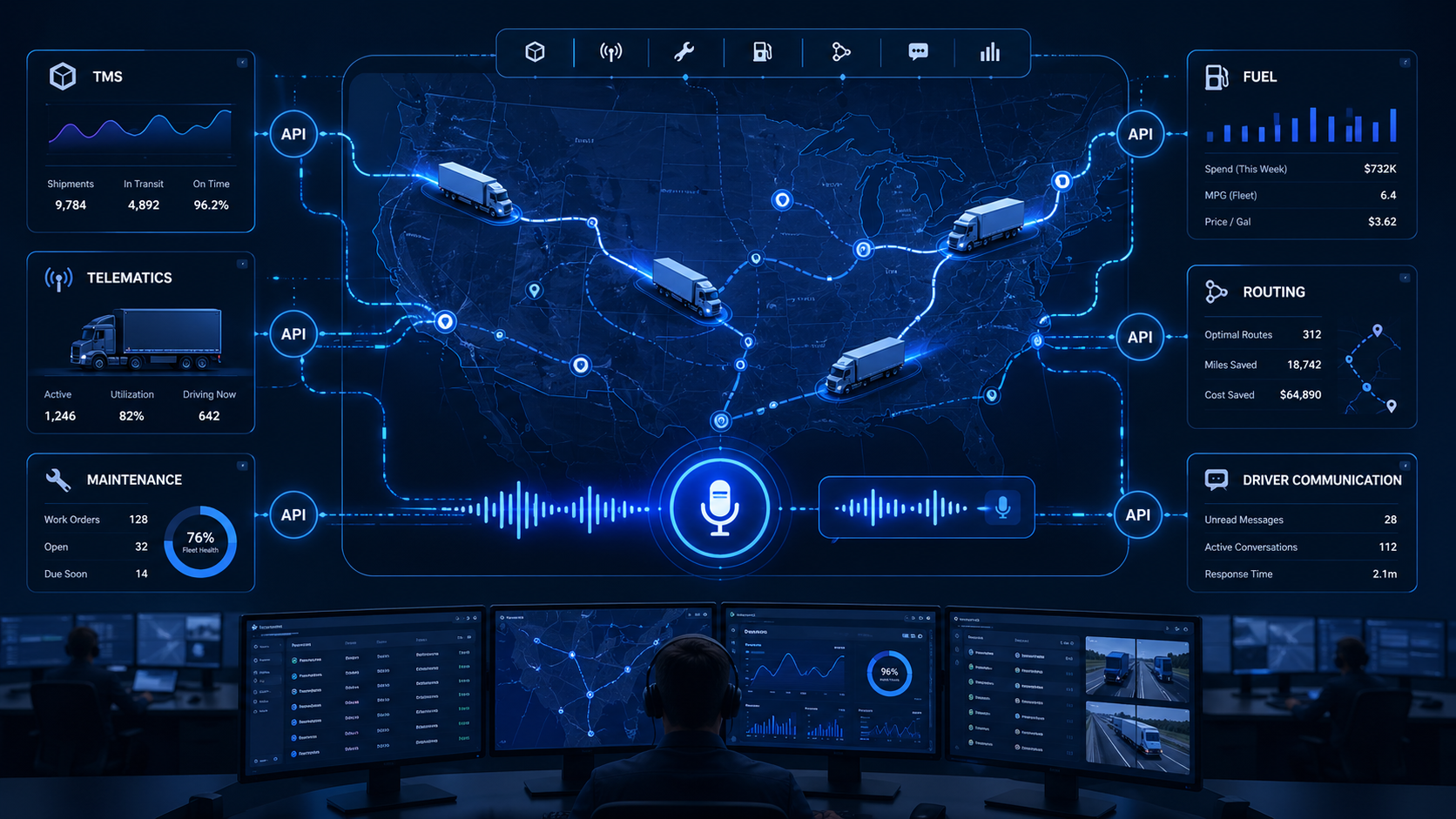
Fleet management systems integration sounds like a software project, but for carriers it is really an operations project. When a TMS lives in one place, telematics systems live somewhere else, maintenance scheduling lives in another tool, and fuel management sits in its own portal, the result is not just messy reporting. The result is slower decisions, duplicated data entry, more downtime, more breakdowns, and teams that spend too much time chasing updates instead of moving freight.
That is why more operators are rethinking what a fleet management system should actually do. It should not just store records. It should connect fleet management software, vehicle tracking, routing, work order workflows, diagnostics, and driver communication into one operating rhythm. When integrated fleet management is done well, real-time data flows across the ecosystem, dashboards become useful, and managers can make informed decisions with better data accuracy instead of relying on guesswork.
Most inefficiencies in fleet operations do not come from one dramatic failure. They come from small gaps between systems. Dispatch may have one view of vehicle location, maintenance may have another view of vehicle health, and finance may have a separate view of fuel costs and operational costs. None of those teams are technically wrong, but they are working from different timestamps, different workflows, and different assumptions.
That disconnect creates friction everywhere. A dispatcher may route a truck without knowing a diagnostic alert is pointing to a maintenance issue. A shop manager may plan maintenance scheduling without a clean feed of route planning and load commitments. A fleet leader may review fuel consumption, fuel usage, and uptime in a dashboard that is already outdated. Even simple functions like GPS tracking, work order creation, or fuel card reconciliation can become manual cleanup jobs when software integration is missing.
This is why fleet management systems integration matters. It reduces duplicated effort, cuts down on data entry, and gives every team a shared operating picture. Instead of manually stitching together telematics data, TMS activity, fuel management records, and maintenance events, the business gets end-to-end connectivity across the tools it already uses.
Not every carrier needs to connect every application on day one. The best place to start is with the workflows that affect revenue, downtime, and driver safety most directly. In practice, that usually means connecting the fleet management system with the TMS, telematics platforms, routing tools, maintenance software, and fuel systems.
The TMS should push load status, route planning, and operational context into the broader fleet management ecosystem. Telematics systems should provide real-time data on vehicle location, diagnostics, driver behavior, and potential breakdowns. Fleet maintenance systems should turn those signals into work order actions, preventive service triggers, and predictive maintenance decisions. Fuel card and fuel management data should connect back to route performance, idle time, and fuel consumption trends.
When these data flows are connected, fleet data becomes more valuable. A carrier can compare routing decisions against fuel costs, review diagnostics alongside uptime, and understand how driver safety events relate to maintenance and operational efficiency. That is a far more practical use of technology than buying another standalone dashboard.
The real payoff of integration is speed. Real-time visibility changes how operators respond to changing conditions. A fleet manager can see when telematics data indicates a rising risk of downtime. A dispatcher can adjust routing based on vehicle location, road conditions, and active maintenance constraints. A safety lead can connect alerts to coaching workflows before a minor issue becomes a serious event.
This is where many fleet management platforms overpromise and underdeliver. They collect plenty of telematics data, but they do not move that data into the right operational workflow. Real-time data only matters when it is tied to a decision. A location ping by itself is not enough. A diagnostic event by itself is not enough. An alert becomes useful when it triggers the next action: reroute the load, schedule service, notify the driver, update the customer, or review fuel usage against route conditions.
Integrated fleet management helps teams move from observation to action. Instead of waiting for someone to pull reports from Geotab, a maintenance tool, and a TMS, the carrier can build automation around those signals. That makes it easier to streamline decisions and optimize resources without adding more manual work.
A useful integration strategy is rarely about one big platform replacement. More often, it is about clean API connections, reliable data mapping, and disciplined workflow design. The API layer matters because it lets fleet management solutions exchange data across tools without constant imports, exports, or spreadsheet workarounds.
That said, software integration is only half the job. The other half is deciding which system owns each piece of truth. If the TMS owns dispatch milestones, let it own them. If telematics owns GPS tracking and diagnostics, use that as the source. If the maintenance platform owns work order status, keep it there. Then design the workflow so those systems share the data they need rather than forcing teams to re-enter the same information in three places.
This approach improves data accuracy and makes dashboards more trustworthy. It also reduces the common problem where teams stop believing the numbers because every system tells a slightly different story. Better connectivity means fewer reconciliation headaches, fewer stale reports, and better cost savings over time.
For many carriers, the missing piece is not another dashboard. It is execution. Teams still need to call drivers, confirm status, follow up on missed messages, and route exceptions to the right person. That is where a voice AI layer can add leverage.
Hyperscale’s positioning makes sense in this context because integrated fleet management is not only about data collection. It is about turning signals into action for dispatch and driver operations teams. A voice AI platform can sit on top of real-time fleet data and automate the first layer of communication. It can check in with drivers, gather updates, capture delays, and route the right information back into the TMS or fleet management system without forcing dispatchers to spend the day on repetitive phone work.
That improves response time without breaking the system architecture. Instead of creating another disconnected tool, voice AI works best when it connects to the broader operational workflow. That means driver communication, exception updates, and status collection become part of the same integrated process as routing, maintenance, and fleet performance monitoring.
A smart rollout starts with one or two high-friction workflows. Good examples include maintenance-triggered dispatch updates, route changes based on real-time data, or fuel management tied to route planning and idle trends. Pick a workflow with visible operational pain, define the source systems, and document the action that should happen when data changes.
From there, create clear ownership. Decide which team manages the API relationship, which team validates the workflow, and which metrics matter. Common measures include downtime, data entry hours, on-time performance, fuel costs, and the number of manual touches needed to complete routine tasks. If integration is working, those metrics should move in the right direction even before every system is connected.
Keep the rollout practical. Do not try to redesign every process at once. Build one clean use case, test the connectivity, confirm the data flows are reliable, and then expand. That approach is usually more effective than launching a cutting-edge transformation program that overwhelms operations in the first month.
One common mistake is treating dashboards as the finish line. Dashboards matter, but they do not solve workflow problems by themselves. Another mistake is connecting systems without defining business rules. If nobody agrees on what should happen after a diagnostic alert or route deviation, the integration will surface more noise rather than creating clarity.
Carriers also run into trouble when they over-customize too early. Not every function needs a custom build. Start with the most valuable data flows, validate them, and then expand to more advanced use cases like predictive maintenance or automated routing adjustments. Finally, do not ignore driver communication. If the back office becomes more connected but the driver still gets updates through fragmented calls and texts, the operating model is only half improved.
Fleet management systems integration is really about making the business easier to run. The technology matters, but only because it helps people act faster and with more confidence. When TMS workflows, telematics systems, maintenance scheduling, fuel management, and driver communication are connected, the carrier gets better visibility, fewer inefficiencies, stronger uptime, and more reliable decision-making.
That does not require chasing every new fleet management platform on the market. It requires connecting the systems that already matter, improving data accuracy, and making sure real-time insights lead to real action. For carriers that want to optimize fleet performance, reduce operational costs, and build more resilient operations, integration is one of the highest-leverage moves available.
Fleet management systems integration connects the tools a fleet already uses, including TMS, telematics, maintenance, routing, safety, and dispatch systems, so data can move across the operation instead of staying trapped in separate dashboards.
Integration matters because fleet teams often lose time switching between disconnected systems, manually updating information, and chasing status across tools. When systems are connected, dispatchers and operations teams can make faster decisions with more accurate, real-time information.
Most fleets should prioritize integrations between their TMS, telematics platform, ELD, maintenance system, safety tools, email, scheduling tools, and customer communication workflows. The goal is to create one operational view instead of forcing teams to manually piece together information.
AI improves integration by turning connected data into action. Instead of simply showing alerts or status updates, AI can trigger workflows, escalate exceptions, update systems, and help dispatch teams respond faster.
Hyperscale Systems has pioneered a unified AI agent platform that transforms operational communications across physical industries. Founded by logistics technology veterans with deep expertise from leading companies like Samsara, Hyperscale integrates seamlessly with major TMS, FMS, and telematics providers to deliver contextual agentic workflows that eliminate operational bottlenecks while enhancing human capability.




